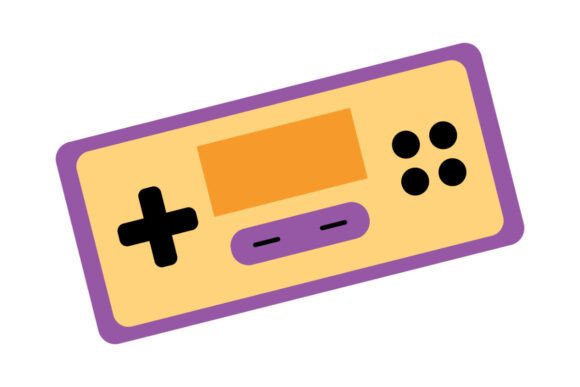
Retro Game Controller: Vintage Art for 80s Gaming Designs
Some design sparks are instantly recognizable—the chunky D-pad, the curved grips, the glowing color accents that defined an entire era of play. The Retro Game Controller illustration offered here captures that spirit in a bold yellow, purple, and black palette. It’s a single digital download delivered in two complementary formats: one PNG file and one SVG file. That simplicity makes it a speedy solution for anyone who needs a dash of arcade nostalgia without hiring an illustrator or spending hours searching for the right asset. You might be putting together a birthday flyer for a gaming party, building a Twitch overlay for a retro stream, or preparing classroom materials for a game-themed lesson. Wherever old-school energy matters, this ready-made artwork slots into your workflow.
Because the file is already created, you skip the drawing process and jump straight to layout. Yet the two file types mean you are not stuck with one rigid look. Anyone who works with digital graphics knows that having both a high-resolution raster image and an editable vector outline opens up different doors depending on the project, budget, and skill level. This single controller illustration might be the centerpiece of a t-shirt print or the tiny favicon on a blogger’s website, and it can hold up in both roles.
One Graphic, Many Questions: Why the Format Matters
In a world where design assets often come as a one-size-fits-all JPEG, the choice to include a PNG and an SVG is a thoughtful nudge toward quality. The PNG file serves as your go-to for quick integration. It has a transparent background, so you can layer it over any backdrop—a neon grid, a textured cardboard look for a party handout, or a solid color block on a web banner—without awkward white boxes ruining the mood. The resolution is fixed, meaning it works beautifully for screen use, social media graphics, blog post headers, and printed materials up to a certain scale.
The SVG version changes the game for someone with vector editing software like Inkscape, Adobe Illustrator, or Affinity Designer. Being vector-based, it scales to the size of a billboard without turning fuzzy. You can also select individual shapes—maybe you want the shell to stay yellow but shift the buttons to a glowing pink for a synthwave remix. You can replace colors, adjust line weights, or isolate parts of the controller to use as standalone icons. For a professional designer, this flexibility transforms a single $5–$15 asset into dozens of variations, repurposed across client work, brand kits, and promotional series.
Who Actually Reaches for Retro Game Controller Art?
Different people see the same image through entirely different lenses. A blogger writing about gaming history might want a quick header image that sets the mood without distracting from the text. They’ll likely reach for the PNG, drop it into a WordPress post, and publish inside of five minutes. The controller acts as a visual signpost that helps readers immediately understand the topic. Meanwhile, a small business owner selling enamel pins or stickers is thinking about print resolution and whether the design can be separated from its background for a clean die-cut line. For them, the SVG is the hero, allowing precise edits to match manufacturing requirements.
An educator crafting a reward chart for a class might use the controller illustration as a playful icon next to student names. Clean, high-contrast shapes help when pages are printed on basic office printers. The specific colors—yellow, purple, black—remain readable even when ink levels are low. A Twitch streamer, on the other hand, incorporates the art into emotes, alerts, or scene transitions. They need something that looks sharp at 112 pixels and still crisp on a large monitor. The SVG export covers both, and the transparent PNG fits seamlessly into green-screen layouts.
Often, the asset works hardest for marketers and event planners. Consider a retro console tournament night at a local bar. An organizer builds a quick poster in Canva: the controller illustration sits prominently, paired with an 8-bit font and a neon grid. The poster gets shared on Instagram, printed as a table tent, and turned into a digital sign inside the venue. One asset, three uses, all because the file types support digital and print without extra file conversions.
How Beginners and Experienced Users Approach the Same File
For a beginner, the simplest path is often the best. The PNG means no learning curve. Open a free online editor like Canva or Photopea, upload the image, resize it, maybe add a drop shadow or a retro frame, and export. The transparent background saves the headache of manual erasing. An absolute newcomer does not need to understand vectors or nodes to get a great result. The controller’s design is already complete; they are just placing it into their creation.
A more experienced designer will likely open the SVG and spend ten minutes tweaking colors to match a brand palette. Perhaps the project requires a specific shade of purple to align with a company logo. Instead of recoloring pixel by pixel, the vector shapes update in seconds. They might remove the d-pad and use it as a standalone motif for a website’s loading spinner. This kind of deconstruction is only possible because the SVG holds structured, layered information, not a flat image.
Between these two extremes sits the adventurous hobbyist. They start with the PNG for a family event shirt, then gradually learn vector basics to customize the SVG for a friend’s streaming channel. The file pair grows with the user’s confidence, making it a sound learning tool as well as a practical asset.
Projects That Shine with a Yellow, Purple, and Black Palette
The 1980s arcade scene was unapologetically loud with color. Yellow commands immediate attention; purple adds a slightly futuristic, neon-soaked depth; black grounds the whole composition. This particular controller illustration leans into that combination in a way that pairs beautifully with specific design themes. Synthwave aesthetics thrive on these hues, so if you are designing a music playlist cover for a vaporwave or retrowave channel, the art slots in without needing heavy color correction.
Birthdays and game nights are obvious candidates. Picture an invitation where the controller replaces the “O” in “JOYSTICK PARTY.” Or use it as a scoring card for a classic console tournament. Because the palette is so deliberate, it also matches well with pixel art frames, glowing neon borders, and dark backgrounds that mimic old CRT monitors. Event planners often lean into this consistency, pairing the controller with free retro fonts to create a cohesive look in under an hour.
Merchandise creators—those selling mugs, phone cases, or notebooks—find that this illustration works as a standalone icon. A small embroidered patch or a screen-printed shirt benefits from the limited color count. Fewer colors often mean lower printing costs for screen printing or embroidery, without sacrificing impact. The yellow and purple contrast maintains visual pop even at small scale.
Practical Examples for Different Reader Profiles
- The weekend creator: Use the PNG to make a custom gaming room wall print. Upload it to an online canvas print service, add a retro pattern background, and hang it above your console setup at home.
- The Etsy shop owner: Import the SVG into a cutting machine software and create adhesive vinyl decals for laptops and water bottles. The vector paths guide the blade, and the bold shapes ensure a clean cut every time.
- The nonprofit educator: Design a simple game board for a math activity. The controller icon marks different difficulty levels, and students love the connection to video games. Print the PNG on cardstock without worrying about complex editing.
- The social media manager: Craft a series of throwback posts for #ThrowbackThursday. Overlay the controller on vintage TV screen mockups and pair it with trivia about old games. The artwork gives each post a consistent brand feel.
- The freelance designer: Keep the SVG in a digital library for client projects that need retro gaming elements. It becomes a reusable asset that saves hours of drawing time while still allowing deep customization to fit each client’s brief.
When Ease of Use Is the Top Priority
Many buyers simply want to finish a project today. They do not intend to become graphic design experts. The transparent PNG answers that urgency. It is ready to use in Google Slides for a last-minute presentation, in an invitation maker app, or in a simple document. The design’s recognizability does the heavy lifting, signaling “retro gaming” immediately without additional explanation. This quick-start quality appeals especially to small business owners who handle their own marketing after hours and cannot afford a full design session.
When Creative Control and Quality Take Center Stage
Other scenarios demand pixel-perfect precision. A publisher creating a book cover for a gaming culture essay needs print-ready resolution and the ability to modify the art to fit a layout grid. The SVG’s scalability ensures that the controller stays crisp when enlarged to a full cover spread. A marketer building a large-format trade show banner at three meters wide cannot risk a blurry image. Vector art is non-negotiable here. The ability to break apart the illustration also lets the designer use only the buttons as repeating background motifs, which can look more sophisticated than the full controller plastered everywhere.
Matching the Asset to Your Own Goals and Skill Level
Before downloading, it helps to ask a few direct questions. Do you need a finished illustration that works immediately, or do you plan to alter colors, shapes, or layout? If the former, the PNG will be your friend. If the latter, make sure you have access to vector-compatible software and are comfortable with basic node editing. The learning curve is not steep—many free tutorials walk through recoloring an SVG in minutes—but if you have never opened a vector file, factor in fifteen minutes of orientation.
Consider your output medium. For web and social media, either file works. For print, especially large-format or commercial merchandise, the SVG is safer. For personal projects like scrapbooking or homemade cards, the PNG on a home printer looks great. No wrong answers, just a match between file capabilities and project demands.
Think about color coherence with your existing brand or theme. The yellow, purple, and black palette is striking but specific. If your project revolves around pastel tones or earth colors, the illustration may clash unless edited. The SVG gives you freedom to recolor entirely; the PNG is stuck with its original shades. This can be a deciding factor for small business owners whose brand colors do not include the given palette.
Long-Term Value of a Well-Chosen Digital Art Download
A versatile asset like this retro game controller illustration earns its place in a resource folder across months or years. The same image might appear in a blog post one week, on a local event flyer the next month, and inside a digital scrapbook a year later. Because it is a timeless nostalgic icon, not a trendy seasonal graphic, it resists feeling dated. Gaming nostalgia has sustained cross-generational appeal, from adults who grew up with classic consoles to younger audiences discovering retro gaming through remakes and indie titles. That cultural staying power increases the long-term usefulness of the single download.
Additionally, having both file formats means you rarely need to convert or hunt for alternatives. The PNG covers quick tasks; the SVG covers scalable or editable needs. This dual-file approach is a small but meaningful detail that saves frustration when a project suddenly changes scope. You won’t find yourself scaling a tiny PNG to three times its size and accepting a pixelated mess.
Is This Retro Game Controller Art Right for You?
This particular illustration works best when you need a single, distinctive controller graphic that communicates retro gaming without additional clutter. It is not a set of multiple controllers, nor is it a full-blown scene illustration. The appeal lies in its focus. If your project requires a hero image that instantly says “80s game night” or “vintage arcade,” this file delivers that message directly. It eliminates the need to search stock photo sites where generic gamepads often come with restrictive licenses or uninspired lighting.
Think about the practical scope of your next three projects. If any of them involve a gaming party invitation, a stream overlay, a retro-themed product listing, a classroom game board, a blog header, or a nostalgic social media post, this download could shorten your workflow by an hour or more. The cost of the asset—often lower than a single cup of coffee—makes it a low-risk option even for experimenters who are still learning design tools.
At the same time, it does not pretend to replace a custom illustration brief. If you need a very specific controller model, multiple angles, or a hyper-realistic rendering, a dedicated illustrator remains the right path. But for a vibrant, clean, and instantly nostalgic controller ready to drop into dozens of creative scenarios, the SVG and PNG pair provides a practical shortcut with surprising range. That combination of speed, quality, and genuine retro flavor is exactly what makes a well-crafted digital vintage asset so useful across such a wide span of creators and professionals.