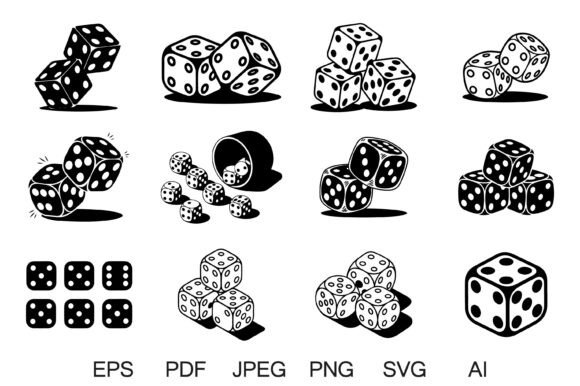
Dice Clipart Vector Bundle
The visual language of chance and play carries an almost universal appeal. Whether pinned to a community board, embedded in a digital invitation, or stamped on merchandise, the image of dice instantly communicates risk, luck, and shared social experience. For designers, marketers, and small business owners who need to harness that energy without starting from scratch, a well-curated Dice Clipart Vector Bundle becomes more than just a set of images — it transforms into a creative utility that saves hours while elevating final output. The bundle in question includes 16 unique illustrations of stacked, rolling, and scattered dice, all rendered in bold black and white styles that adapt seamlessly across print and digital media.
What makes this particular collection immediately relevant is the way it sits at the intersection of several creative needs. Traditional dice icons often feel generic or overly complex, with unnecessary gradients and outdated shading. This bundle strips the imagery down to high-contrast forms that read clearly at any size. The inclusion of multiple file formats — Ai, EPS, SVG, PDF, PNG, and JPG — signals that the creator understands how modern workflows actually function. A freelance illustrator might open the editable vector files to tweak a die’s pip placement. A small business owner with no design software might simply drag a PNG into Canva. That range of accessibility is no longer a luxury; it is an expectation users carry into every download.
Why Bold Black and White Dice Illustrations Are Gaining Traction
Color trends in illustration move in cycles, but the current preference for bold, high-contrast graphics goes deeper than aesthetics. In a content-saturated environment, clarity becomes a competitive advantage. A black and white dice illustration cuts through the noise on a social media feed, a poster, or a product label because the eye processes it almost instantly. There is no confusion about what the object is or what it represents. For casino-themed events, board game cafes, and even educational materials about probability, that directness matters.
Furthermore, the shift toward dark mode interfaces and minimalist branding has made monochromatic design elements more valuable. A white dice icon on a dark background feels native to modern UI, while the same graphic printed on kraft paper for a craft project retains its handmade charm. The Dice Clipart Vector Bundle fits this trend because each of the 16 illustrations is built on shapes, not effects. They do not rely on drop shadows or metallic textures that break down in different contexts. Instead, they offer a timeless base that users can recolour, overlay, or leave untouched according to their project’s needs.
Real-World Applications Across Multiple Creative Fields
One of the most practical ways to understand a clipart bundle’s value is to trace how different people might use it on an average Tuesday. Consider a board game designer prototyping a new dice-rolling mechanic. They need placeholder art for rulebooks and playtester cards. The SVG files from this bundle drop straight into Affinity Publisher or Adobe InDesign without any resolution concerns. The sharp vector lines mean that when the rulebook goes to print — even at 300 dpi — the dice remain crisp.
Now pivot to a craft blogger creating a free printable for a family game night. She wants a sheet of dice cut-outs that readers can use to assemble a DIY dice tower. The bundled PDF and PNG formats let her arrange the illustrations neatly in a word processor or free design tool. She can write a quick tutorial, package the dice images, and publish a resource that drives newsletter signups. The fact that the illustrations show dice in various states — stacked, rolling mid-air, scattered across a surface — adds motion and narrative to what could otherwise be a static page.
Then there is the event marketer promoting a charity casino night. The invitation needs to feel both upscale and playful. Using one of the stacked dice illustrations as a featured graphic, she builds a flyer that hints at craps tables and roulette wheels without needing separate photoshoots or licensed stock imagery. The vector files also allow her to scale the artwork to banner size without degradation, something raster-only bundles often fail to deliver. Across all these scenarios, the Dice Clipart Vector Bundle acts less as decoration and more as a ready-made component of visual communication.
Navigating the File Formats Included in the Download
A common hesitation around clipart purchases is whether the files will actually open in the software someone already owns. This bundle addresses that worry by spanning both vector and raster ecosystems. Ai and EPS files serve professional designers who work in industry-standard environments — Adobe Illustrator, CorelDRAW, or Affinity Designer. These formats preserve all editable paths, so a user can isolate a single die, change its stroke weight, or even extract the pip pattern as a separate design element.
SVG has become the bridge format between professional design and web development. It is XML-based, meaning it can be manipulated with code for responsive websites, interactive graphics, or data visualizations. A developer building an online dice probability simulator can grab the SVG, style it with CSS, and even animate the rolling dice without touching a pixel-based tool. For crafters working with cutting machines like Cricut or Silhouette, SVG is often the native format that translates paths into cutting lines, opening up vinyl decals, cardstock assemblies, and heat-transfer vinyl projects.
The PDF and PNG formats ensure that users without vector software are not left behind. A PDF can be opened in any browser or standard reader and often imports into programs like Microsoft Word or Google Docs without distortion. PNG files come with a transparent background, making them ideal for layering over photos, textures, or patterned papers. JPG rounds out the bundle with a familiar, widely supported format for quick placement in presentations, emails, or basic photo-printing setups. The inclusion of all six files means the bundle meets people where they are, rather than demanding they learn new tools first.
How Dice Imagery Connects to Current Entertainment and Business Trends
Board game sales have remained resilient as people seek offline social experiences. That resurgence has created a ripple effect: tabletop cafes need signage, game creators need packaging graphics, and YouTubers need thumbnail art for playthrough videos. Dice are central to that economy, so having a diverse set of dice illustrations that don’t look like clipart from 2008 is a genuine asset. The Dice Clipart Vector Bundle, with its 16 distinct poses, supports this ecosystem by offering variety. Instead of rotating the same single die graphic and calling it a day, a content creator can mix stacked dice for a “strategy” section, rolling dice for a “luck” section, and scattered dice for a “chaos” section, building a more engaging visual hierarchy.
Simultaneously, the gambling and casino industry continues its shift toward responsible gaming messaging and entertainment-focused events. Visuals need to emphasize fun, not just risk. The bold, clean style of these illustrations leans toward the game-playing aspect rather than a gritty neon aesthetic, which makes them appropriate for wider audiences, including family-friendly game nights or educational materials about odds and probability.
Practical Tips for Getting the Most Out of a Dice Clipart Vector Bundle
To truly integrate these illustrations into a workflow, it helps to think beyond merely placing a dice image on a canvas. Layer the illustrations with your own typography to create custom logos for game clubs or poker nights. Because the files are vector-based (in their Ai, EPS, and SVG forms), you can convert the dice shapes into custom letterforms or combine them with text elements without worrying about alignment artifacts.
Experiment with negative space. The bold black shapes can be inverted — white dice on a black background — to create striking contrast for social media posts. A scattered dice pattern can become a subtle background texture in a newsletter header if you reduce the opacity and use it as a repeating motif. The consistency across the 16 illustrations means that blends of multiple poses still feel cohesive, so you can design a brand kit for a gaming channel where the intro bumper, lower third, and end card all use elements from the same bundle.
For makers and crafters, the vector paths in the SVG can be imported directly into laser engraving software. Engraved dice coasters, keychains, or wooden box lids become feasible products that you can sell on platforms like Etsy. The timeless black silhouette style means the design transfers cleanly to physical materials, and customers don’t need color printing, which reduces production costs. This aligns with the rising interest in maker-market income streams, where digital assets feed directly into physical product creation.
Understanding the Evolving Expectations of Digital Asset Consumers
People purchasing clipart today are more discerning than they were a decade ago. They have experienced bloated bundles with hundreds of files they never touch, or they have been burned by raster-only images that blur when sized up. There is a noticeable shift toward smaller, more intentional collections where each illustration serves a purpose. A bundle with 16 unique illustrations strikes that balance — enough variety to tell a story, but not so much that the user wastes time sorting through near-duplicates. The bold black and white constraint actually increases rather than limits usefulness because it eliminates the need to harmonize mismatched color schemes.
The demand for multi-format delivery is also tied to the way side hustles and primary businesses blend together. A single user might need print-ready PDFs on Monday, editable vectors on Tuesday, and web-optimized SVGs on Wednesday, all for different clients. The Dice Clipart Vector Bundle solves that fragmentation without requiring multiple purchases or conversion tools. This convenience speaks directly to the solopreneur reality where time spent reformatting files is time taken away from billable creative work or family life.
Bringing Dice Illustrations Into Educational and Non-Commercial Projects
Beyond commerce and entertainment, the bundle extends naturally into educational contexts. Math teachers introducing probability can use the clean dice images in worksheets or interactive whiteboard presentations. The simplicity of the design avoids distracting younger students while still feeling mature enough for adult education environments. The PNG files with transparent backgrounds make it easy to create digital flashcards where dice faces appear over question marks or problem prompts.
Nonprofits organizing board game fundraisers or community game nights can use the illustrations on flyers and social media without worrying about licensing complications typical of stock photo sites. Typically, clipart bundles like this grant broad usage rights, but checking the specific license is always wise. The fact that so many formats are included suggests the creator intends for these to be used widely, which aligns with the needs of community-oriented projects that operate on tight marketing budgets.
In an era where visual assets are often consumed and discarded in hours, a versatile set of dice illustrations endures because the core symbol — the die — does not age. Trends in typography, color, and layout change, but the simple geometry of a cube with pips remains instantly recognizable. By choosing bold black and white vectors over stylized 3D renders, the Dice Clipart Vector Bundle secures a place in long-term asset libraries rather than being tied to a fleeting visual fad.
Integrating Vector Dice Into Modern Content Strategies
For content creators and marketers, the visual consistency of a unified illustration set becomes a silent branding advantage. Imagine a financial literacy blog that uses dice imagery to illustrate risk management concepts. Using the same dice style across multiple articles creates a visual signature that readers subconsciously recognize. The 16 unique poses prevent repetition fatigue while maintaining that signature. A post about diversification might show scattered dice, while a post about taking calculated risks might show a single die rolling, mid-tumble. The bundle gives that flexibility without forcing the writer or designer to commission new art each time.
Search engine optimization for visual content also benefits from using authentic, original illustrations rather than overused stock photos. When you embed a custom dice graphic from this bundle into a blog post and add appropriate alt text — for example, “bold black and white dice clipart showing stacked dice” — you signal relevance to search engines in a way that generic stock photo filenames do not. Over time, this contributes to the overall topical authority of a site that produces gaming, crafting, or educational content.
The Dice Clipart Vector Bundle ultimately represents a shift in how designers and non-designers alike approach digital assets. It prioritizes clarity, adaptability, and multi-format usability. Whether you are printing a vinyl decal for a dice tower, building a casino-themed website, or designing a simple birthday invitation, the 16 illustrations provide a robust starting point that feels intentional rather than generic. In a world where visual clutter is the default, the clean strike of a black and white die on a blank background can be exactly the right message.